
Cooling Tower Fill Replacement
At some point, cleaning the fill stops working. We will tell you when you have reached it.
Lower Energy Consumption
Clean heat transfer surfaces improve system efficiency.
Reduced Operating Costs
Use less energy and extend equipment life.
More Sustainable Operations
Lower energy use means a smaller environmental impact.
Reliable Performance
Keep your cooling systems running at their best.
Fill is where a cooling tower does its actual work. It spreads water into a thin film across a huge surface area so air can carry the heat away. It is also the part of the tower that fouls worst, because everything the tower pulls out of the air ends up there.
Scale, biological growth and silt build up in the fill pack over years. Heat transfer drops. Airflow restricts. Water starts channeling through the paths of least resistance instead of distributing evenly, and the tower quietly loses capacity. In severe cases, scale accumulates until the fill collapses under its own weight and takes structural components with it.
Cleaning handles most of this. Up to a point.
Past that point, the fill has degraded beyond what any cleaning restores, and continuing to clean it is throwing money at a component that needs replacing. Cooling tower fill replacement is the right answer then, and we will tell you which situation you are in. We would rather give you an honest answer and keep you as a client than sell you a replacement you did not need.
Signs your fill needs replacing
- Heat transfer performance has not recovered after cleaning
- Visible collapse, sagging or breakage in the fill pack
- Heavy scale that cleaning no longer removes
- Water channeling instead of distributing evenly across the pack
- Rising approach temperature with no other explanation
- Fill that has reached the end of its expected service life
What we do
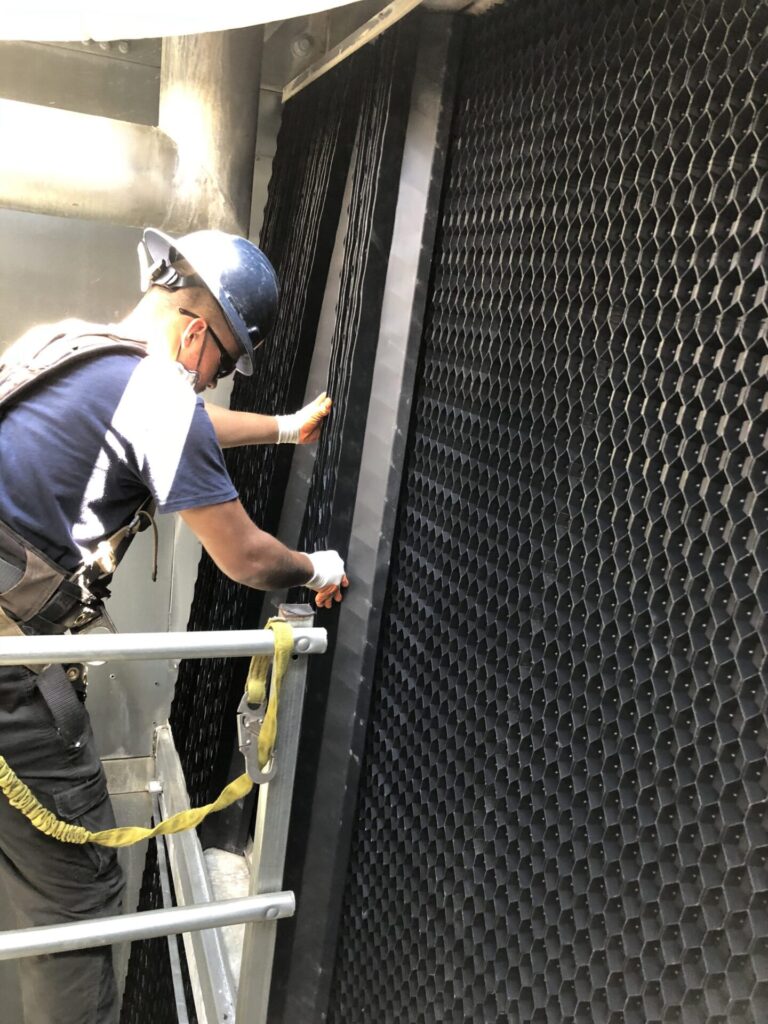
We remove the old fill pack, clean the tower interior while it is open and accessible, and install new fill and drift eliminators. Having the tower open is the best chance you will get to inspect and clean components that are normally unreachable, and we use it.
The work is documented like every other job, which matters if the replacement is going through a capital process or a utility efficiency program.
FAQS
Questions About Cooling Tower Fill & Replacement
How long does cooling tower fill last?
Service life depends on water quality, treatment program, fill type and operating conditions. Well-maintained fill in a well-treated system lasts many years. Fill in a poorly treated or heavily fouled tower degrades much faster. Condition matters more than age, which is why it is worth having assessed rather than replaced on a calendar.
Can fouled fill be cleaned instead of replaced?
Often, yes. Cleaning restores a great deal of performance on fill that has not structurally degraded. Once the pack has collapsed, broken down or scaled past the point where cleaning recovers heat transfer, replacement is the economical answer. We assess it and tell you which applies.
What causes cooling tower fill to fail?
Scale accumulation, biological fouling, silt loading, chemical attack from improper treatment, UV degradation on exposed fill, and physical damage. Scale weight is the most common cause of outright collapse, because a fill pack saturated with mineral deposit can carry many times its design load.
Will replacing fill improve efficiency?
If the existing fill is degraded, yes. Restoring designed heat transfer lowers condenser water temperature, which reduces the load on your chiller. The improvement depends on how far the current fill had fallen off.
How much does fill replacement cost?
It depends on tower size, fill type, access and how much of the tower is being addressed at the same time. Send us the tower details and photos and we will quote it.
Should we clean the tower at the same time?
Yes. With the fill removed, interior surfaces are accessible in a way they never are otherwise. It is the most efficient time to do a thorough cleaning and inspection, and it costs less than two separate mobilizations.