
Cooling Tower Cleaning and Disinfection
Is your cooling tower program documented well enough to survive an inspection?
Lower Energy Consumption
Clean heat transfer surfaces improve system efficiency.
Reduced Operating Costs
Use less energy and extend equipment life.
More Sustainable Operations
Lower energy use means a smaller environmental impact.
Reliable Performance
Keep your cooling systems running at their best.
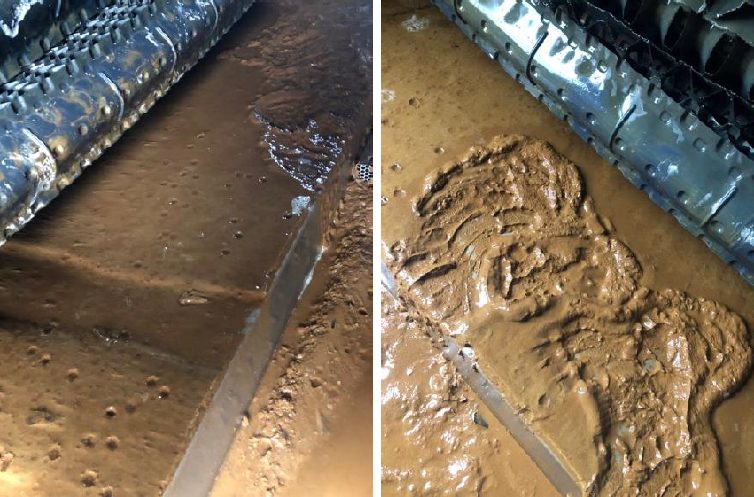
A cooling tower is a nearly ideal environment for biological growth. Warm recirculating water, sunlight, organic debris pulled in from the air, and enormous surface area inside the fill. Left alone, that becomes biofilm, and biofilm brings scale, corrosion, sludge and the conditions Legionella needs to multiply. It also destroys heat transfer. The same fouling that creates a health risk raises condenser water temperature, and every degree of that lands on your chiller as extra work. Water treatment controls the chemistry. It does not remove what has already accumulated on the fill and in the basin. That takes mechanical cooling tower cleaning, and that is what we do.
What the standards require
OSHA guidance on cooling towers and Legionella recommends that towers be cleaned and disinfected at least twice a year, typically before startup at the beginning of the cooling season and again after shutdown in the fall. Towers with heavy biological fouling, or towers that have sat idle for an extended period, should be cleaned before returning to service.
The regulatory picture has tightened considerably since then. ASHRAE Standard 188 established the framework requiring buildings with cooling towers to develop and maintain a documented, site-specific water management program, and ASHRAE 514 expanded on it. Healthcare faces more: CMS mandates water management program compliance for Medicare and Medicaid participating facilities, and the Joint Commission requires hospitals and nursing care centers to maintain a program addressing Legionella and other waterborne pathogens. A growing number of states have added cooling tower registration, routine testing and mandatory reporting thresholds.
What these requirements share is documentation. A cleaning that is not recorded may as well not have happened when an auditor asks for the file.
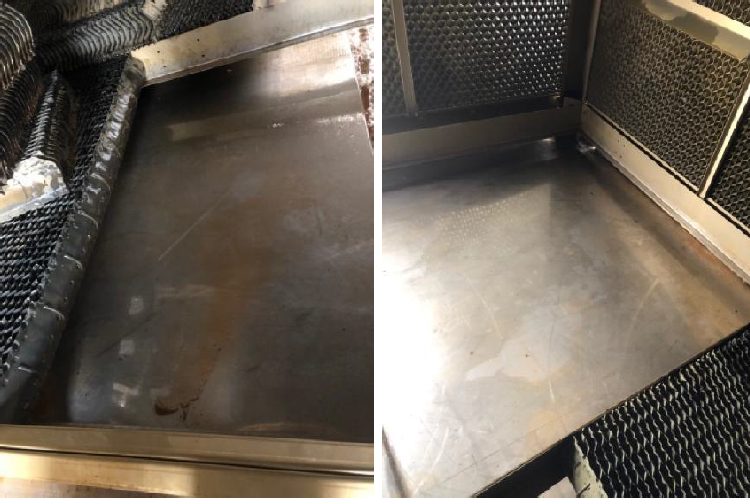
Northeast Coil provides written certification that your towers were professionally cleaned, describing the work performed and the condition of the equipment.
Those records support your cooling tower compliance obligations, your internal risk management file and your response to outside auditors.
The energy argument
Cooling tower cleaning is usually sold on compliance. The money is in efficiency.
A clean tower delivers colder water to the chiller. Published industry figures generally put chiller efficiency improvement at roughly 1 to 1.5 percent for every degree Fahrenheit that entering condenser water drops below full load design, and closer to 2 percent per degree when entering water is running above 85F. On a large plant running most of the year, that compounds into real money.
It also lightens the load on the chiller itself, which means less runtime, less wear and longer service life on the most expensive equipment in the plant. Cooling tower energy efficiency is one of the few improvements that costs a fraction of the equipment it protects.
Why it matters
- Regulatory requirements around cooling tower hygiene continue to tighten
- Failure to document a cleaning program carries real legal and financial exposure
- Clean towers deliver measurable energy savings through better heat transfer
- Mechanical cleaning is the direct defense when preventing Legionella in cooling towers
- Fouling caught early is cheaper than fill that has to be replaced
Our process
Our process targets the microbiological growth that leads to scaling, corrosion and sludge. Those biofilms reduce heat transfer efficiency and create the conditions dangerous bacteria need.
Our cooling tower cleaning services run from single-cell rooftop units through large industrial cooling tower installations at manufacturing plants and power facilities.
We clean the basin, the fill, the distribution system, the drift eliminators and the fan housing. The fan housing in particular is a chronic problem area, because condensation forms there and chemical treatment often cannot reach it. Then we disinfect, and then we document.
Cooling tower maintenance programs
Most towers need cleaning at least twice a year, which makes them a natural fit for scheduled cooling tower preventive maintenance.
Bundled cooling tower services on a set interval mean the work lines up with your startup and shutdown windows, the documentation stays current, and you are not scrambling to book a crew in the middle of the cooling season.
Fill replacement
Cooling tower fill has a service life. When it is fouled past the point where cleaning restores performance, or when it has begun to collapse under scale weight, replacement is the right call rather than another cleaning.
We remove and replace fill and drift eliminators, and we will tell you honestly which one you need. Recommending a replacement you do not need is a good way to lose a client, and we would rather keep you.
Who we work with
From industrial facilities to healthcare campuses, data centers and commercial buildings, reliable cooling is essential to keeping operations running. Our cooling tower services help maintain system performance, protect critical equipment, improve efficiency and support consistent water quality across demanding environments.

Manufacturing and power generation
Process cooling loads do not tolerate downtime. Plants rely on tower performance to keep production equipment within temperature and the line running.

Hospitals and healthcare campuses
Healthcare carries both the highest patient risk and the strictest water management obligations. Documentation is not optional here.

Data centers
Evaporative cooling is what makes high-density computing possible, and tower fouling translates directly into thermal headroom you no longer have.

Commercial and institutional buildings
Universities, office towers and residential high-rises depend on central plant performance for comfort, occupancy and operating cost.
Why choose us
Preventive maintenance should not feel like an outage.
Our process is built to get the tower clean with minimal shutdown time, which is the single biggest objection facilities managers have to scheduling this work. We plan around your operation, bring the crew size to finish in the window we committed to, and leave you with certification of what was done. It is why clients keep us as their cooling tower cleaning company rather than rebidding it every year.
FAQS
Questions About Cooling Tower Cleaning
How often should a cooling tower be cleaned?
OSHA guidance recommends cleaning and disinfecting cooling towers at least twice a year, generally before startup at the beginning of the cooling season and after shutdown in the fall. Towers with heavy biological fouling should be cleaned immediately, and towers out of service for an extended period should be cleaned before returning to service. Facilities in high-fouling environments often move to quarterly.
What is the difference between cooling tower cleaning and water treatment?
Water treatment manages the chemistry of the circulating water to control scale, corrosion and biological growth on an ongoing basis. Cleaning physically removes what has already accumulated in the basin, on the fill and throughout the tower. They are complementary, not interchangeable. A well-treated tower still needs mechanical cleaning, and many water treatment companies bring us in to perform it.
Does cooling tower cleaning reduce Legionella risk?
Mechanical cleaning removes the biofilm and sediment Legionella grows in, which is why it is a core element of essentially every water management program framework. It works alongside water treatment, monitoring and testing rather than replacing them. No single measure eliminates the risk on its own.
Do we have to shut down the tower during cleaning?
A full mechanical cleaning requires the tower offline. We plan the work around planned shutdowns, off-peak periods, nights and weekends, and size the crew to finish inside the window. Tell us your constraints before we quote and we will build the schedule around them.
How long does cooling tower cleaning take?
It depends on tower size, fouling and access. A single small tower can be a same-day job. Large multi-cell towers or heavily fouled systems take longer. We give you a realistic window before the crew arrives.
What documentation do we receive?
Written certification that your towers were professionally cleaned, describing the work performed and the condition of the equipment. Reports are available through our cloud storage system and are used for water management program records, internal risk management, outside audits and utility rebate submissions.
How much does cooling tower cleaning cost?
It varies with tower size, number of cells, fouling condition and site access, which is why most cooling tower cleaning companies will not publish a price. Send us the system details and a few photos through the quote form and we will give you a real number rather than a range.
Do you clean towers as a subcontractor for water treatment companies?
Yes, regularly. Water treatment providers bring us in for the mechanical cleaning portion of their programs. We are set up to work as part of an existing service relationship rather than around it.