
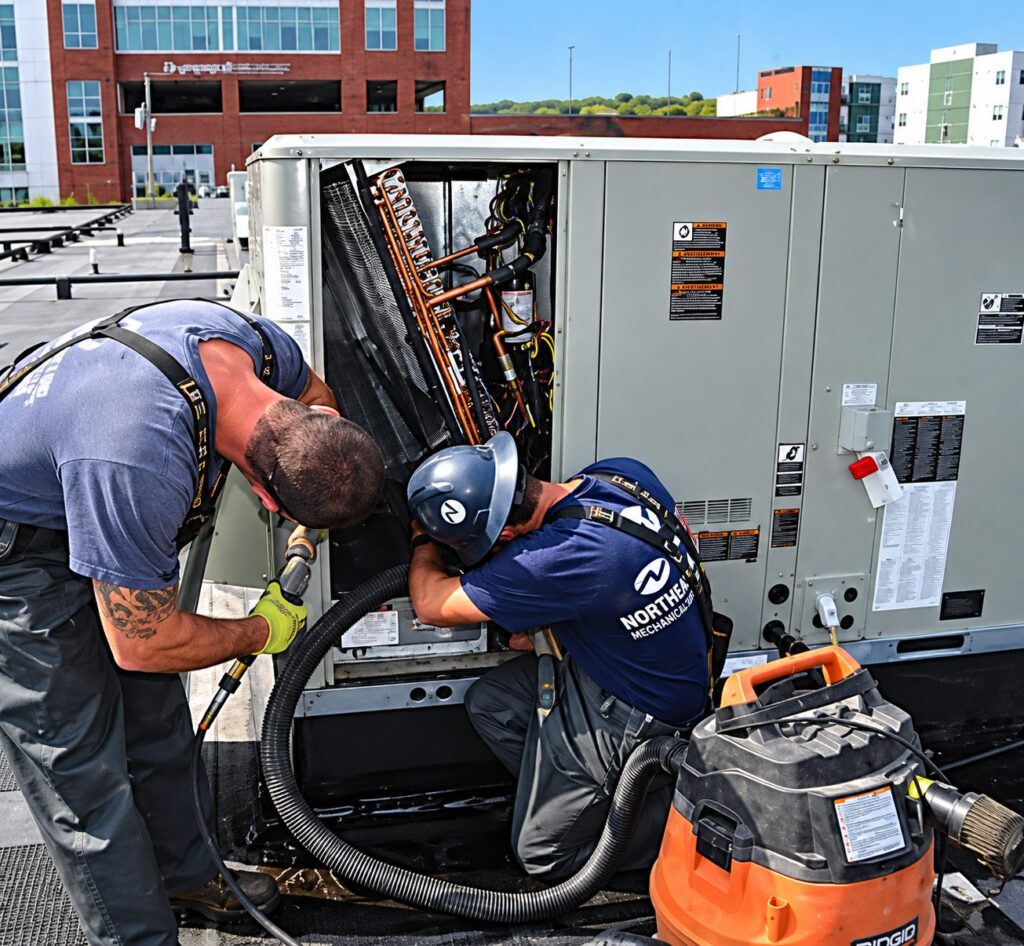

The cheapest cleaning is the one that happens before something breaks.

Lower Energy Consumption

Clean heat transfer surfaces improve system efficiency.

Reduced Operating Costs

Use less energy and extend equipment life.

More Sustainable Operations

Lower energy use means a smaller environmental impact.

Reliable Performance

Keep your cooling systems running at their best.

Most facilities call us the first time because something has gone wrong. Capacity has dropped, energy costs have climbed without explanation, an auditor asked for records nobody had, or a system failed on the hottest day of the year.

Almost all of it was preventable, and it was preventable cheaply.

Fouling is gradual. Coils load up over months. Scale builds in chiller tubes over seasons. Cooling tower fill degrades over years. None of it announces itself, which is exactly why it gets deferred, and why the bill arrives all at once as a failed compressor or a capacity shortfall during a heat wave.

A commercial HVAC preventative maintenance program replaces that with a schedule. The work happens on a known interval, the documentation stays current, and the budget becomes a line item instead of a surprise.

Programs are built around your equipment, not around a package we are trying to sell. Depending on the facility, that can include:

  • Cooling tower maintenance and disinfection, typically twice a year
  • Chiller and condenser tube cleaning, typically annually during a planned shutdown
  • Condenser coil cleaning, annually or more often in high-fouling environments
  • Air handler maintenance and evaporator coil cleaning, scheduled around occupancy
  • Walk-in cooler, unit cooler and refrigerated warehouse evaporator cleaning
  • Refrigerated display case cleaning
  • Cooling tower fill inspection, with replacement when cleaning no longer restores performance
  • Documented service reports on every visit, retained in cloud storage
92cd0860 a41d 4c2c 8a7b 2aa9931bd96d

There is no universal answer, and anyone who gives you one without seeing the equipment is guessing.

Cooling towers are generally cleaned at least twice a year, before startup and after shutdown. Condenser and evaporator coils are usually annual at minimum, and quarterly in kitchens, food processing and dusty industrial settings. Chiller tubes are commonly annual, driven by trending approach temperature rather than the calendar.

What actually sets the interval is the operating environment. A rooftop condenser in a clean suburban office park and the same unit behind a restaurant exhaust fan are not on the same schedule. We look at the equipment, we look at what we find on the first visit, and we recommend an interval we can defend.

A planned program gives your facility a consistent maintenance schedule instead of waiting for problems to become failures. Regular service helps control costs, identify repairs early and keep your equipment ready when you need it.

improve heat transfer
Predictable cost

Scheduled work is budgeted work. Emergency service is overtime labor, expedited parts and whatever the failure cost you in production or product.

reduce energy consumption
Documentation that stays current

An audit, an insurance review or a rebate submission is not the moment to discover your records have a two-year gap. A program keeps the file complete without anyone having to think about it.

extend equipment life
Problems found early

Our technicians document equipment deficiencies on every visit. On a program, somebody is looking at your equipment on a regular schedule and telling you what they see, while it is still a repair.

maintain water quality
Equipment that lasts

Systems not fighting fouling, scale and restricted airflow run closer to design and last closer to their rated life. Cleaning a chiller is not expensive. Replacing one is.

reduce energy consumption
Scheduling that works

Program clients get planned around. We know your shutdown windows, seasonal constraints and access requirements before the truck is dispatched.

We run programs across grocery chains, healthcare systems and distribution networks, with consistent scope and consistent reporting at every location. One schedule, one standard, one place to find the records.

HVAC preventive maintenance is scheduled cleaning and inspection of cooling, heating and refrigeration equipment on a set interval, rather than waiting for a failure or a performance problem. For Northeast Coil that means cleaning heat transfer surfaces and water systems, documenting equipment condition, and flagging deficiencies before they become emergencies.

Cooling towers are generally cleaned at least twice a year. Condenser and evaporator coils are typically annual at minimum, and more often in kitchens, food processing and dusty industrial environments. Chiller tubes are commonly annual, usually scheduled around a planned shutdown. The right interval depends on the equipment and the environment it operates in.

Usually yes, if the facility has equipment that matters to the operation. The value is not only the discount on scheduled work. It is that the cleaning happens on time, the documentation stays current, and somebody is looking at the equipment regularly enough to catch problems early.

Yes. Multi-site programs across grocery, healthcare and distribution clients are a significant part of our work, with the same scope and reporting standard at every site.

We document it and tell you. Our reports flag equipment deficiencies so you can address them on your own timeline rather than discovering them during a failure. We do not perform mechanical repairs, so there is no incentive on our side to find work that is not there.

Some utility efficiency programs support this kind of work, generally through custom or retro-commissioning incentives rather than standard equipment rebates. Requirements vary by utility and change year to year. What we can tell you is that these programs require documentation of the work performed, and we provide it on every visit.

Yes, and most clients do. The first visit tells us what condition the equipment is in, which is the only honest basis for recommending an interval.

Scroll to Top